
St Augustine of Canterbury - Our Patron Saint
St Augustine of Canterbury holds a special place in the life and history of our College. His mission to England in the late sixth century shaped the foundations of Christianity in this country and continues to inspire our Catholic life today.
Pope Gregory, the Anglo-Saxon children, and the mission to England
Pope Gregory the Great is traditionally linked with one of the most well-known wordplays in early Church history. According to the Venerable Bede, Gregory encountered fair-haired Anglo-Saxon children being sold as slaves in a Roman market. When told they were called Angli (Angles), Gregory replied:
“Non Angli, sed angeli” 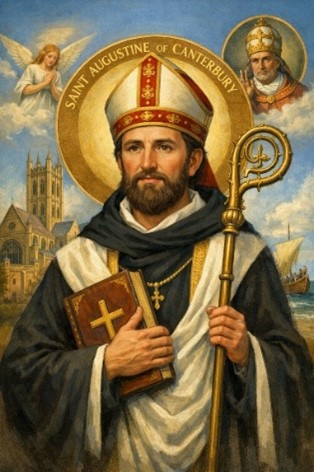
(“Not Angles, but angels.”)
This story is recorded in Bede’s Ecclesiastical History of the English People (Book II, Chapter 1), written in the early eighth century. Bede explains that Gregory was struck both by the children’s appearance and by the fact that they came from a land that had not yet fully received the Christian faith. The phrase captures Gregory’s conviction that the English people were worthy of salvation and should be brought into the life of the Church.
This encounter helps explain why Gregory later sent St Augustine of Canterbury to England in AD 596. Gregory knew that Christianity had survived in parts of Britain and Ireland, but that many Anglo-Saxons remained pagan. As Pope, he felt a pastoral responsibility to spread the Gospel and saw England as both a spiritual challenge and an opportunity.
Rather than using force, Gregory chose a missionary approach rooted in patience, dialogue and respect for local culture. He instructed Augustine to preach peacefully, to adapt existing customs where possible, and to transform pagan places of worship rather than destroy them. This careful and compassionate strategy led to the gradual conversion of the Kingdom of Kent and laid the foundations for Christianity in England.
The mission to England begins!
In AD 596, Augustine was sent to England from Rome by Pope Gregory the Great. England at this time was largely pagan, and Augustine’s task was challenging. Travelling with around forty monks, he faced fear, uncertainty and cultural difference. At one point, he was so anxious that he returned to Rome! Pope Gregory encouraged him to continue, reminding him not to abandon a good work once it had begun and sent him back to England.

Augustine arrived in the Kingdom of Kent in AD 597, where he met King Æthelberht. Although the king was not initially Christian, he listened carefully to Augustine’s message and was struck by the Christian promise of hope and eternal life. Augustine was permitted to preach openly, and many people chose to be baptised. Within a few years, the king himself became Christian.
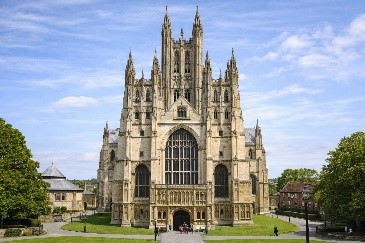
Augustine was later appointed bishop and established a centre of worship and learning at Canterbury, laying the foundations for what would become Canterbury Cathedral, still a place of Christian witness today. Guided by Pope Gregory, Augustine showed respect for local culture, transforming existing places of worship rather than destroying them — a powerful example of dialogue, wisdom and mission.
At our College, St Augustine of Canterbury reminds us that faith requires courage, resilience and trust in God. His story encourages us to persevere when things feel difficult, to serve others with humility, and to live out our faith in a way that transforms both hearts and communities. His mission continues through us, in our learning, our worship and our daily life together.
Close
Social Media